11/12/07
Designers drape them in priceless creations. They are the envy of
millions, while fantasy owners employ them as a crystal ball for
performance. Models, whether clad in fashions or statistical, are
the stuff of which dreams are made. It is no wonder so many are
oblivious to their inherent flaws.
Granted, some of the experts out there are pretty good at what
they do, but others are accurate at a level of 50% according to
FFToday staff writer D.J.
Nestrick. This puts them in the same statistical accuracy
as a coin toss. It also means people using attractive models are
predicting performance at the same level of the traditional opening
of a football game. Thankfully FFToday is working at a level of
57% accuracy second only to Yahoo and RotoWorld who are running
at 62.5%. It appears no one has cornered the market on fantasy
football prophet.
There are numerous reasons for this level of inaccuracy in fantasy
football. Being 100% accurate is nearly impossible, but you would
think experts in their fields might be in the upper 70’s
or lower 80 percentiles. This is not, after all, baseball where
someone hitting a high speed spinning orb 30% of the time is considered
a hero worthy of many millions of dollars. It is just football
and with all of the stats readily available on virtually any football
web site one would think they should have an edge. Heck, there
are even pay sites which boast about their accuracy to a level
where people are willing to drop actual money for their advice.
Still, many do a fantastic job of upholding the obvious while
ignoring the potential. I count myself as among this less than
elite group.
I was so excited for this fantasy season to start it was stupid.
For the first time in a decade I had the first pick in the draft,
naturally I selected everyone’s number one, LaDanian Tomlinson.
After his performance last year, as well as the changes in the
Charger organization I had a double lock winner. “Marty
Ball” had been permanently abandoned. The wide-open offense
of Norv Turner was going to unchain the monster within LT. I felt
born again, until week three of this season.
What started out so bright was cast in shadows. My commissioner
had given me the kiss of death by saying he was impressed with
my receivers. Of course by week three between all five of them
they had one score and almost 200 total yards. With my receiving
corps near death, my season was in darkness. I found myself in
second to last place. In the midst of my early season depression
I received an email which would turn my season 180 degrees.
One of our owners wrote me proposing a trade; Tomlinson for
Santonio Holmes and, I thought, Joseph Addai. I wrote him an email
accepting the trade, then forwarded one to the commissioner. Evening
brought a phone call from “The Man.”
“Are you sure you want to make this deal?” he queried.
“Yeah, is there a problem?”
“It kind of looks like you said awe screw it and took the
deal without thinking.”
“That’s true, why the phone call?” I queried.
Our league is pretty much a free market. It is rare for any trade
to be questioned by any of us.
“Just checking,” there was the pregnant pause, “So
you are going to trade LT for Adrian Peterson and Santonio Holmes?”
The silence on my end of the line was deafening. Finally I spoke
up, “*&% I thought it said Joseph Addai,” Grand
Canyon size pause, “I gave my word the deal is set.”
“I thought you might have made a mistake. You can back
out of this if you want, it is not done yet.”
Again silence, “Naw. I gave my word. As stupid as it sounds,
this season is already in the tank. I am trying to be a good sport.
I’ll keep my word and go with it. I Okayed the deal, I will
live with my idiocy.”
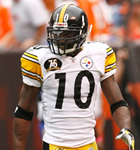 I
hung up the phone feeling more depressed than I was at the start
of the day. I felt moronic. I knew the rest of the league was
laughing at me. They should have a great time at my expense. My
misery had been reduced to entertainment. I had given up the most
valuable player in virtually every fantasy league last year for
a damn rookie along with a so-so receiver in a running offense
with an existing number one receiver. I
hung up the phone feeling more depressed than I was at the start
of the day. I felt moronic. I knew the rest of the league was
laughing at me. They should have a great time at my expense. My
misery had been reduced to entertainment. I had given up the most
valuable player in virtually every fantasy league last year for
a damn rookie along with a so-so receiver in a running offense
with an existing number one receiver.
I plowed ahead to week four knowing I was doomed for another
season; by the end of the day I was pleasantly surprised. The
performance of the rookie and the so-so receiver, along with the
first week Maurice Jones-Drew actually showed up, got me out of
cellar. I inched towards the middle of the pack. After a few weeks
I was out of the middle edging towards the top, then came this
last weekend.
On paper the Vikings-Chargers game looked like a snoozer. LaDainian,
accompanied by the defensive minded Chargers, against the quarterbackless,
receiverless, Vikings who had the number three defense against
the run. It looked like the perfect spot of LaDainian to have
a terrific day. Phillip Rivers should shred the Viking defense
in the air with Gates and newly acquired Chris Chambers. The big
guys on the Viking defense should wear themselves out rushing
the QB in vain. While the Charger “O” ate offense,
the Viking offense would be a testament to the futility of “three
and out” as an offensive game plan.
The Viking offense, if there really was one, struggled to find
a starter at QB. Between Tavarias Jackson, Brooks Bollinger and
Kelly Holcomb there had been nothing in the way of stability at
the position. Their front line had not protected them. Between
the injury bug and the search for actual talent, the Nordic QB
corps did not strike fear into the hearts of defenses around the
league.
The big money people in Vegas had made the Chargers a 7 1/2
point favorite on the road. It is their way of saying. It was
the Vegas way of saying the Vikes had a snow ball’s chance
in Hades of surviving this game. The “spread gods”
had spoken. There was no chance the Vikings could win this game.
The talking heads and prognosticators across the league agreed.
The script for the game looked like Rivers and the flying circus
go crazy grinding the Vikes to pulp, then the slash and burn running
attack of the Lightening Bolts takes over late in the first half
and the entire second half as the hapless Purple and Gold are
pounded into puppy chow. LT was rated the number one back of the
week on virtually every web site while Rivers made a rare appearance
in the top ten of Sportsline. The poor Nordsmen from Minnesota
never had a chance; then the game started.
The first TD is scored by LT on a one yard run. Peterson matched
it with his own score. Then the game begins to be turned on its’
head when Antonio Cromartie set a new NFL record with the run
back of a missed field goal of 109 yards for a score. The first
half ends with the Chargers in the lead 14-7 and looking sort
of like how the script should go. The talking heads still felt
the Bolts had the game as they had pushed around the Vikes. With
Jackson at QB the Vikes had looked nothing short of terrible,
it could only get worse when Merriman and crew got their collective
stuff together. It did get worse.
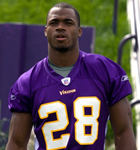 The
third quarter had Peterson getting another TD, then things exploded.
Peterson went crazy. He had to do something. By the end of the
game the two Viking quarterbacks (Jackson got hurt) ended the
game with a combined 158 passing yards with one score to the ever-present
Sidney Rice. Not only did Peterson explode, he incinerated the
Chargers by gaining 296 rushing yards and scoring three times.
He also had 19 yards with one reception for a total of 315 combined
yards. No matter how you score in your fantasy league, this performance
was off the hook. The
third quarter had Peterson getting another TD, then things exploded.
Peterson went crazy. He had to do something. By the end of the
game the two Viking quarterbacks (Jackson got hurt) ended the
game with a combined 158 passing yards with one score to the ever-present
Sidney Rice. Not only did Peterson explode, he incinerated the
Chargers by gaining 296 rushing yards and scoring three times.
He also had 19 yards with one reception for a total of 315 combined
yards. No matter how you score in your fantasy league, this performance
was off the hook.
To make this even more embarrassing for the Thunder from Down
Under California was the fact they scored a mere three more points
in the second half. LT was thwarted with pedestrian numbers, 77
total yards and one score while gates and Chambers combined for
69 yards. They lost by a score of 35-17.
Instead of being depressed I am the happiest man in the league.
I finally have a shot at making the money this year and the last
laugh could come from me. My integrity is in tact and I know some
of the owners are beginning to think I am on the shrewd side.
I do nothing to discourage them.
Football is not game which fits into a ready-made mold. It is
what makes the game so addictive. There are 22 guys on the field
playing in an atmosphere of controlled mayhem. At times it may
seem as a brutal ballet, but it is one of the toughest spectator
sports to make sense out of at times. The number of variables
existing on any given play when almost two-dozen people are in
full motion, at full speed, with aggressive intent is off the
hook. It is also what makes this such an entertaining means to
an exciting end.
After the performance in the Viking game, I received great performances
from almost all of my players. I racked up a league record 205
points moving me three more positions up in the league. At third
place over all I am not sure how long I will stay there, I will
enjoy my stay at this lofty position.
Anyone who claims to have created the perfect model for computing
fantasy performance is two beers short of a six pack. Football,
like many runway models, is a seductive mistress whose simplistic
beauty is fleeting.
The premise of football is easy. Take a ball and some big guys.
Knock down as many people on the opposition side of the ball.
Get fast guys who can outrun their guys being knocked down. What
you have is an offensive performance which is predictable, easy
to model; best of all it is logical. The problem is, just like
the runway variety of models, nothing can measure the size of
neither a player’s heart, nor the variables inherent with
22 guys going full speed crashing into one other. It is what makes
fantasy seasons an out of control rollercoaster ride we love,
or love to hate.
Following up stunning performances from last week, Santonio Holmes
paled in comparison while Peterson may be looking at sometime
on the bench. He is a casualty of the improving Packer defense
and will likely be out at least a few weeks. Can someone show
me the model to predict when a player is going be injured? A lot
of love is being sent by owners all over the fantasy world to
an ailing player in Minnesota.
|