  A Fantasy Football Community! |
|
|
| Log In | Sign Up
| Contact |
|
|
|
|
|||
Rebuilders Digest: Dynasty Buy, Sell & Cut Targets
|
||||||
| By Dustin Ludke | 6/5/26 | Follow @theDunit13 |
| Dynasty managers are starting to come alive. Message boards are active, and trade offers are flying. While rookie hype continues to swirl, managers who aren't contending this season can take advantage of the excitement and make moves that improve both their roster and long-term outlook. Welcome back to the monthly installment of Rebuilders Digest for May 2026. BuyWR Drake London, Atlanta Falcons There is going to be plenty of name fatigue surrounding Drake London, but he remains a valuable dynasty asset. Rebuilding managers can take advantage of that fatigue -- and what many perceive as a "down" season -- to acquire him at a discount. Let's start with the value. London is currently valued around WR9 in dynasty rankings. While that may seem expensive for a rebuilding team, you're still getting him at a lower cost than many of his peers. Part of that discount comes from his WR19 finish last season. What many people overlook is that he accomplished that in only 12 games. London still possesses top-five upside, and players with that type of ceiling are rarely available. While his overall finish was disappointing, London still scored seven touchdowns after posting nine the previous season when he finished as the WR5. His underlying metrics remained remarkably similar. He averaged 75 receiving yards per game, more than nine targets per game, and 5.5 receptions per contest. The production dip was largely a result of missing games rather than a decline in performance. Much of London's discounted value stems from uncertainty at quarterback. Tua Tagovailoa was brought in to compete with Michael Penix Jr., and a new coaching staff led by Kevin Stefanski adds another layer of uncertainty. We don't know who the starter will be or how efficient the offense will be. What we do know is that London has several factors working in his favor. First, he'll play the 2026 season at just 25 years old and is entering the prime years of his career. Second, Stefanski's offenses have historically funneled targets toward a primary receiver. Outside of tight end Kyle Pitts, there isn't another pass catcher on the roster who should seriously challenge London for volume. We've seen receivers such as Jerry Jeudy thrive on opportunity in this style of offense. To put London's age into perspective, Buffalo's recent draft pick Skylar Bell is already 24 years old. London is also nearly eight months younger than George Pickens, who is frequently viewed as one of dynasty's premier young receivers. Most importantly, London has already shown he can produce regardless of quarterback play. Whether he remains in Atlanta long term or eventually changes teams, his dynasty value should remain intact. We're talking about a receiver entering his prime who doesn't receive the same level of hype as others in his tier. That's exactly the type of player rebuilding managers should target. He has the profile to become a cornerstone asset for years to come. Even if it costs an early first-round pick this year or next, London is the type of player who can anchor your rebuild. SellRB Tony
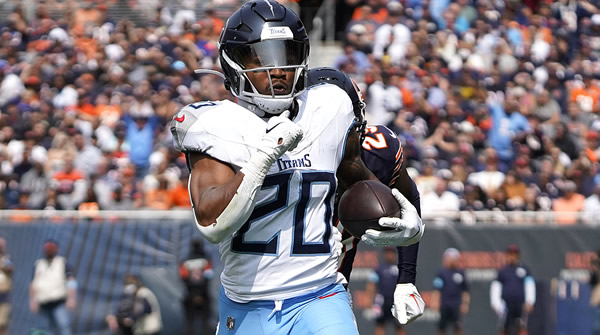
Pollard, Tennessee Titans There may not have been a bigger winner from the NFL Draft than Titans running back Tony Pollard. Many analysts expected Tennessee to select a running back early, especially after being linked to Jeremiyah Love throughout the pre-draft process. Instead, Love went one pick earlier to Arizona, and the Titans waited until the fifth round to draft Nicholas Singleton out of Penn State. As a result, Pollard remains firmly atop the depth chart and is positioned for another significant workload in what should be an improved offense. Quarterback Cam Ward should continue developing, and rookie receiver Carnell Tate adds another weapon to the passing attack. Ironically, that's exactly why Pollard is a sell. Last season, Pollard ranked 12th among running backs in carries and 25th in targets despite sharing the backfield with Tyjae Spears, who finished 12th among running backs in targets himself. Even with that workload, Pollard finished as the RB23. A major issue was touchdown production. He scored only five rushing touchdowns and received just 19 red-zone carries, ranking 44th in the league. From a dynasty perspective, the larger concern is age and situation. Pollard is entering his eighth NFL season and will be nearly 30 years old this year. While he spent much of his early career as a backup and doesn't have the mileage of some veteran backs, he's still approaching the point where dynasty value tends to fall off quickly. He's also entering the final year of his contract and will hit a crowded free-agent market alongside a strong incoming rookie class. Another concern is Tennessee's offensive line. The Titans did little to improve it in either free agency or the draft. Pollard averaged just 2.6 yards before contact per rush last season, ranking 30th in the NFL. He remained productive largely because of his explosiveness, recording 27 runs of 10 or more yards, the ninth-highest total in the league. That's an impressive number, but it's difficult to project explosive-play efficiency from year to year, particularly for an aging running back behind a weak offensive line. Right now, Pollard's value is buoyed by projected volume and a favorable depth chart. Rebuilding managers should capitalize on that. A late first-round pick or an early second-round pick is a reasonable return. Given the outlook of future draft classes, I'd prefer targeting 2027 capital if possible. You could also explore deals involving younger assets such as WR Josh Downs or TE Chigoziem Okonkwo. For a rebuilding roster, turning a declining veteran into future assets is exactly the type of move that accelerates a turnaround. Roster CloggerRB Ray Davis, Buffalo Bills I'm a Bills fan -- not a casual observer, but a lifelong die-hard. As a fantasy analyst, however, I can't continue recommending that dynasty managers hold Ray Davis. The argument has always been that Davis is the handcuff to James Cook, one of the league's most productive running backs. The problem is that I'm not convinced that's even true anymore. Last season, Davis finished with only eight more carries than Ty Johnson. He played fewer snaps than Johnson and has recorded only two games with double-digit carries while Cook has been active. There's also the age factor. Davis is already 26 years old despite entering only his third NFL season. He was an older rookie, which significantly limits the runway for future value growth. Compounding the issue is his contract situation. Davis remains under a cost-controlled rookie deal through next season. His cap hit is minimal, making him unlikely to be cut, while his limited production and role make him an unlikely trade target. Dynasty managers are essentially stuck waiting for circumstances to change. The problem is that Davis doesn't have a defined role. He isn't heavily involved in the passing game -- that responsibility belongs to Ty Johnson. He should theoretically handle goal-line work, but Josh Allen absorbs a large percentage of those rushing opportunities himself. The counterargument is obvious: if James Cook were injured, Davis could see a meaningful workload. We got a glimpse of that in Week 18 when he rushed 21 times for 152 yards. However, betting on that scenario is difficult. Cook handled 349 touches last season, yet he has missed only one game in four NFL seasons. At this point, Davis is occupying a roster spot based largely on hypothetical value. If you can move him for a third-round pick, it's probably the best return you'll receive. The James Cook manager may even pay slightly more to secure the handcuff. For rebuilding teams, roster spots are valuable. They should be dedicated to players whose value can realistically appreciate over the next two to three years. Davis simply doesn't fit that profile. Even if he receives a temporary opportunity, it's difficult to envision him ever securing a long-term starting role. Sometimes the smartest rebuild move isn't acquiring talent --
it's creating room for a better bet. |
|
FOLLOW US 
 |
|