QB Jacoby
Brissett
(2025 QB Rank: 17, 17.8 FPts/G)
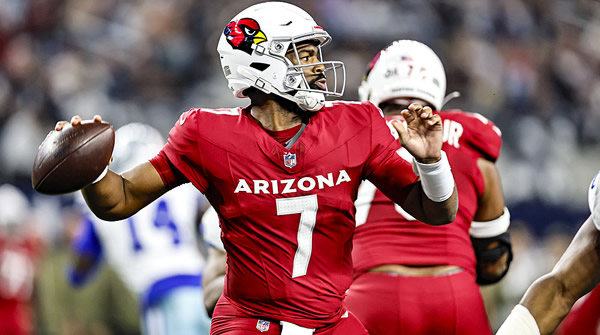
A journeyman in the truest sense of the word, Brissett will spend
a second season with the same team for the first time since his
four-year stint with the Colts, which ended in 2020. And why not?
Brissett ran the offense better than the departed Kyler Murray
did – even though the Cardinals won just one of Brissett’s 12
starts.
For fantasy owners, the veteran proved to be a savvy in-season
addition, throwing for multiple scores in 10 of those dozen outings
and averaging 281 yards per game. As you’d expect, Brissett kept
Trey McBride fed, but he also showed tremendous chemistry with
Michael Wilson, who was a complete nonfactor under Murray.
Despite his statistical success a season ago, Brissett enters
2026 with fringe fantasy appeal. Prior to last year, the 33-year-old
had posted subpar numbers, and when the losses inevitably pile
up in a division with the reigning Super Bowl champions, this
year’s Super Bowl favorites, and an always dangerous 49ers squad,
what’s the reason to keep trotting Brissett out there?
Maybe you can talk yourself into selecting Brissett in the final
rounds to back up a strong QB1, but I’d be surprised if we didn’t
see Gardner Minshew and, eventually, Carson Beck get their turn
in the starting role at some point.
While you can debate whether using the third overall pick on
a running back is a wise use of draft capital for a team with
holes everywhere, you can’t knock Love’s talent. The Notre Dame
product has excellent speed and agility, able to accelerate quickly
and run away from tacklers if he gets into the open field. He’s
also a gifted receiver that isn’t afraid to mix it up in pass
protection.
There’s three-down potential here, even though in the modern
NFL, few offenses deploy their backs in that manner. Given Arizona’s
depth at the position, which includes holdover James Conner and
free-agent signing Tyler Allgeier, who knows a thing or two about
backing up a first-round running back, expect them to follow that
blueprint and give their veterans some burn.
On the surface, that might be seen as a negative, but simply
look at Las Vegas in 2025 with Ashton Jeanty, last season’s rookie
back de jour, to see that being the clear lead back doesn’t necessarily
mean you’re going to be productive. The Cardinals have weapons,
certainly more than the Raiders did, that should prevent teams
from loading the box to stop Love, who is a possible top 20 selection
that offers high-end RB2 potential in Year 1.
Conner is a consummate professional, having spent nine seasons
in the NFL. He has taken a pounding during that time, though,
and entering his age-31 campaign his time in the league looks
to be winding down. Always a durability risk, Conner lasted just
three games in 2025 before suffering a gruesome foot injury that
required season-ending surgery.
Arizona reworked Conner’s deal to keep him with the team for
one more season, but his primary role for 2026 is likely to mentor
Love and ease his transition from college to the pros. With Allgeier
featuring a similar, power-based running style, it’s unclear what
Conner will do on Sundays when all three backs are available.
As such, Conner is best avoided on draft day.
RB Tyler Allgeier
(2025 RB Rank: 52, 6.8 FPts/G)
In his last three seasons with the Falcons, Allgeier averaged
155 carries, 614 yards, and 5 TDs – he posted a 210-1,035-3 effort
as a rookie, but that was before Bijan Robinson arrived. Those
numbers feel a bit high when you consider Arizona’s options in
the passing game, and the presence of Conner behind the highly
touted Love. Still, given his age and durability (he’s missed
one game in his career), Allgeier holds more value than Conner,
checking in as a possible RB5 with some handcuff potential.
As the first non-quarterback drafted in 2024 and the son of an
NFL Hall of Famer, much was expected from Harrison. Through two
seasons, he has not delivered. Apologists can point to uneven
play at the quarterback position, though McBride has excelled
under identical circumstances, and Wilson emerged after the switch
from Murray to Brissett this past season. Harrison also dealt
with some injures in 2025, including a concussion, emergency appendectomy,
and two separate issues with his foot.
Add it all up, and Harrison is suddenly entering a potentially
pivotal year in his young career. The hiring of former Rams OC
Mike LaFleur should help energize the offense, and though Harrison
recently stated he was still not fully recovered from the injuries
he navigated last year, he added that he did not expect them to
linger into the season. The quarterback situation, meanwhile,
remains problematic. While Brissett played well after taking over
for Murray, his history is spotty at best, and the veteran leaned
on McBride and Wilson over Harrison.
Ultimately, though, the ball is in Harrison’s court. We’ve seen
receivers navigate tougher circumstances than this over the years,
and the Ohio State alum needs to start producing numbers more
in line with his talent level. An offseason working with Brissett
should help, as should the change in offense. Despite that, it’s
time for fantasy owners to be a bit more conservative on draft
day, targeting Harrison as a midrange WR3 with the hope that this
is the year it clicks.
WR Michael Wilson
(2025 WR Rank: 21, 10.7 FPts/G)
Coming off two nondescript seasons to open his career, Wilson
began 2025 with eight catches and 52 yards over his first five
games. His numbers ticked up when Murray was replaced by Brissett,
but even then, it didn’t cause many ripples among fantasy owners.
That all changed in Week 11 when Wilson put up a 15-185-0 line
versus the 49ers. He followed it with a 10-118-0 effort against
the Jags. Over the final eight games of last year, Wilson averaged
seven receptions for 96.9 yards and scored six times.
If you project those closing numbers over a full 17-game season,
you’d get 119 catches, 1,647 yards, and 15 touchdowns. Do NOT
expect production like that in 2026. Harrison missed several of
those late-season outings, and the Cardinals were on the wrong
side of numerous blowouts, giving Wilson the benefit of garbage-time
production.
Wilson’s outlook for 2026 is very much a glass half full/half
empty scenario. Optimists can lean on his strong play to close
last season as a coming out party, which combined with him entering
a contract year could result in big production. On the flip side,
perhaps Wilson was a byproduct of blowouts and limited options
around him. Target him as a WR4 with risk/reward potential.
TE Trey McBride
(2025 TE Rank: 1, 14.9 FPts/G)
McBride arrived as a Pro Bowl talent in 2024, catching 111 passes
for 1,146 yards. Touchdowns had always eluded him, though, managing
just six across his first three seasons combined. That finally
changed last year when he scored 11 times, which tied for second-most
in the NFL. It was part of an absolutely monster season in which
McBride established a new NFL record for receptions as a tight
end with 126 to go with 1,239 yards and those 11 touchdown grabs.
The effort earned him a place on the All-Pro Team for the first
time.
With his red-zone deficiencies seemingly addressed, McBride is
the total package for fantasy owners. His week-to-week reliability
is exceptional – he only caught fewer than five passes in a game
once all last season – as is his durability, having only missed
one game the past three years. In 2025, you could have made a
case for Brock Bowers to be the overall TE1. Not now. McBride
is the consensus top fantasy tight end out there and likely a
second-round pick in drafts.
|